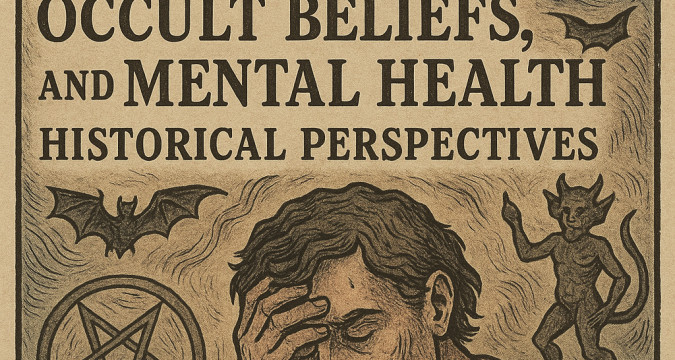
For as long as humans have looked up at the stars, we’ve tried to make sense of the strange things that happen inside our own minds. Why do people act in ways that seem beyond their control? Why do bad things happen without warning? Long before psychiatry, people turned to superstition and the occult for answers — spirits, curses, witchcraft, or divine punishment.
Even today, in a world of neuroscience and therapy apps, those old explanations haven’t disappeared. They’ve simply evolved.
👁️ The Old Beliefs: Spirits, Witches, and Madness
In medieval Europe, mental illness was often seen as a sign of possession or witchcraft. People who heard voices or behaved strangely were thought to be under demonic influence — or to have made a pact with dark forces. The Church prescribed exorcisms, prayers, and punishments instead of medical care.
But not everyone agreed. In the 1500s, a German doctor named Johann Weyer argued that so-called witches were actually people suffering from melancholy (what we’d now call depression). It was one of the first steps toward understanding mental illness as a medical, not moral, issue.
Outside Europe, other cultures had their own versions of these beliefs. In Africa, mental distress was (and often still is) linked to witchcraft or spirit interference. In China, talismans and rituals were used to heal troubled minds. These practices weren’t random — they were part of complex systems for keeping harmony between humans and the unseen world.
🕯️ Why We Still Believe
You might wonder why superstitions survive in a scientific age. Psychologists have a simple answer: control.
When life feels uncertain — during illness, war, or global pandemics — people naturally look for patterns and meaning. Believing that a curse, an evil eye, or unlucky number caused misfortune can actually make the world feel more understandable.
Studies show that superstition tends to rise in times of crisis. During the COVID-19 pandemic, many people turned to charms, rituals, or even conspiracy theories as a way to manage anxiety. Superstition, in this sense, is a coping mechanism — a psychological bandage that covers the wound of uncertainty.
⚕️ When Belief Becomes a Barrier
But there’s a darker side. When people see mental illness as the work of spirits or magic, they might delay getting help.
In one study from India, more than half of people with obsessive-compulsive disorder believed their condition had a supernatural cause — and most visited a faith healer before seeing a psychiatrist. Similar patterns appear across Africa and the Middle East.
This doesn’t mean that spiritual or traditional healers should be dismissed — they often provide emotional support and community. The real problem comes when fear, stigma, or misunderstanding keep people away from the care they need.
🧿 The Stigma of the “Cursed” Mind
In some cultures, mental illness is still seen as a curse, punishment, or sign of weakness. Families may hide their relatives, or communities may avoid those who seem “possessed.” These ideas don’t just harm individuals — they isolate entire families and make recovery harder.
But spirituality and ritual can also play a healing role. Prayer groups, meditation, and traditional ceremonies can bring comfort and belonging. The challenge is separating what helps from what harms — and finding respectful ways to connect traditional beliefs with modern mental health care.
🌍 Bridging Science and Spirit
Modern mental health care is learning that cultural beliefs can’t be ignored. When psychiatrists and therapists understand a patient’s worldview — even if it includes spirits or curses — treatment works better.
In Ghana, for example, some mental-health programs now work with faith healers rather than against them. In these models, traditional and medical practitioners collaborate to provide both spiritual and clinical care.
That approach respects culture while protecting patients from harmful practices — a true middle path between science and spirit.
🪞 Why It Matters Today
Superstition and the occult might seem like relics of the past, but they’re still with us — just in new forms. From astrology apps to TikTok witchcraft, people still seek meaning and control through the mysterious.
Understanding why we believe in unseen forces isn’t just about debunking myths. It’s about compassion. Behind every superstition is a human need — for safety, community, and explanation. And when those needs are met with empathy instead of judgment, both faith and science can help heal the mind.
✨ Key Takeaways
- Superstitious and occult beliefs were once the main way societies explained mental illness.
- Even today, these beliefs influence how people seek help and understand distress.
- Superstition often increases in times of uncertainty — it’s a natural human response to fear.
- Cultural sensitivity in mental health care helps bridge traditional beliefs and modern treatment.
- The goal isn’t to erase superstition, but to engage it respectfully while promoting healing.
In the end, the line between the supernatural and the psychological has always been blurry. Whether we call it “witchcraft,” “energy,” or “mental illness,” the search is the same: to understand the unseen forces that shape our minds — and to find peace with them.

 Postal Address