
When people think about mental health recovery, they often think first about medication, counselling, or therapy. These services are incredibly important and can be life-changing. But research increasingly shows that another type of support plays a vital role in helping people rebuild their lives: peer support.
At Trowbridge Service Users Group, we are proud to provide a welcoming, peer-led community where people can connect with others who have lived experience of mental health challenges.
Our groups are completely FREE. There is no waiting list, no professional referral is needed, you can self-refer, and everyone is welcome.
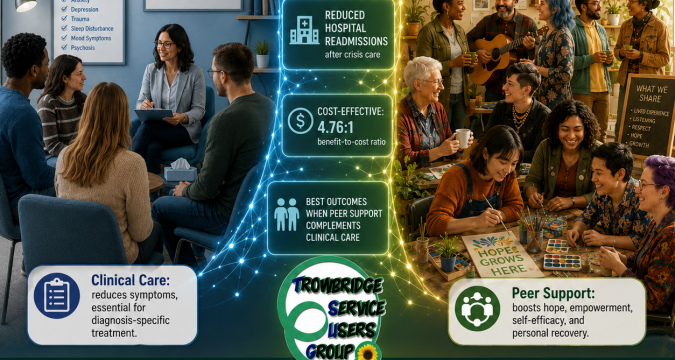
Peer Support Complements Professional Care
One of the most important findings from scientific research is that peer support is not a replacement for clinical mental health services. Instead, it works best alongside them.
Large systematic reviews have found that while peer support does not consistently reduce psychiatric symptoms more than traditional treatments, it provides significant benefits in areas that clinical services alone often struggle to achieve.
Together, professional treatment and peer support create a more complete pathway to recovery.
Building Hope, Confidence and Empowerment
Traditional mental health services often focus on reducing symptoms such as anxiety, depression, or psychosis. These are essential goals.
Peer support, however, focuses on something equally important: personal recovery.
A large meta-analysis involving more than 12,000 participants found that peer support significantly improves:
- Hope for the future
- Self-confidence
- Empowerment
- Self-efficacy
- Social connectedness
These qualities help people move beyond simply managing symptoms and towards rebuilding meaningful, fulfilling lives.
Reducing Isolation and Self-Stigma
One of the greatest strengths of peer support is shared lived experience.
Research has shown that talking with someone who truly understands what you’re going through helps normalise mental health difficulties and reduces feelings of shame and isolation.
Knowing that someone else has faced similar challenges—and found ways to move forward—can inspire hope in ways that textbooks and clinical appointments sometimes cannot.
Helping Prevent Mental Health Crises
Evidence also suggests that peer support can help reduce the need for hospital admissions.
Studies have shown that peer-delivered self-management programmes following a mental health crisis reduce the likelihood of people needing to be readmitted to psychiatric services.
An NHS peer support programme in Nottingham reported a reduction in inpatient hospital stays, improving outcomes for individuals while also reducing pressure on NHS services.
Early support, connection and understanding can make a real difference before difficulties become overwhelming.
Good for People—and Good for the Health System
Peer support isn’t only beneficial for individuals.
Economic research has found that effective peer support services can reduce the need for expensive hospital care, providing excellent value for money.
This means investing in community-based peer support benefits both the people receiving support and the wider healthcare system.
Particularly Helpful for Depression
Research also shows that peer support has been especially effective in supporting people recovering from depression, including postnatal depression.
While peer support should not replace appropriate medical treatment where needed, it can provide encouragement, practical strategies and genuine understanding throughout recovery.
Keeping Expectations Realistic
The scientific evidence is clear that peer support has enormous strengths—but it also has limits.
Peer support should never be viewed as a substitute for psychiatrists, psychologists, GPs or other mental health professionals.
Clinical services remain essential for assessment, diagnosis, medication management and specialist treatment.
The strongest evidence shows that people often achieve the best outcomes when clinical care and peer support work together, combining professional expertise with lived experience.
Everyone Deserves Support
At Trowbridge Service Users Group, we believe nobody should have to face mental health challenges alone.
Whether you’re taking your first steps towards recovery, looking to meet others who understand, or simply want a safe and welcoming community, we’re here for you.
✔ FREE to attend
✔ Self-referral – no GP or professional referral needed
✔ Friendly peer support from people with lived experience
✔ Open to everyone
✔ A safe, welcoming and non-judgemental environment
Recovery is about more than reducing symptoms. It’s about rebuilding hope, confidence, purpose, relationships and belonging.
That’s the power of peer support—and that’s why we’re here.
You are always welcome at Trowbridge Service Users Group.


 Postal Address