

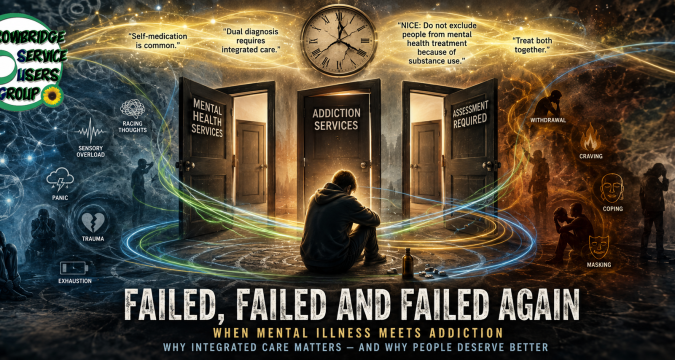
“You need to stop drinking before we can help your mental health.”
For many people living with mental illness or neurodivergence, those words are painfully familiar.
The irony is difficult to ignore. People often begin using alcohol or drugs because they are trying to manage untreated mental health symptoms. Yet when they finally ask for help, they may be told that the substance use must be addressed first before psychological therapy or specialist mental health treatment can begin.
This creates a cycle that many people feel trapped inside.
Self-Medication Is Not Rare – It Is Common
The self-medication hypothesis has been recognised in mental health research for decades. It suggests that many people use alcohol or drugs not simply to become intoxicated, but to reduce emotional or psychological distress.
People commonly self-medicate to:
- numb emotional pain
- reduce anxiety and panic
- silence racing thoughts
- escape traumatic memories
- manage overwhelming sensory input
- improve sleep
- increase confidence in social situations
Research consistently shows that mental illness and substance misuse frequently occur together, often referred to as co-occurring conditions or dual diagnosis. Rather than one causing the other in every case, each condition can worsen the other, creating a vicious cycle.
Why Neurodivergent People May Turn to Alcohol
The issue becomes even more complex for neurodivergent people.
According to Alcohol Change UK, autistic people and people with ADHD may use alcohol for reasons that differ from the general population. These include:
- reducing sensory overload
- easing social anxiety
- masking autistic traits
- coping with exhaustion caused by constant masking
- managing emotional dysregulation
- attempting to slow racing thoughts
- dealing with rejection sensitivity
Many neurodivergent people describe alcohol as making them feel “normal” or allowing them to interact socially with less anxiety. Unfortunately, alcohol only provides temporary relief while often increasing anxiety, depression and executive functioning difficulties over time.
Alcohol Change UK also highlights that neurodivergent people may face additional barriers to accessing addiction services because those services are not always designed around autistic communication styles, ADHD, sensory needs or cognitive differences.
Mental Health and Addiction Are Still Too Often Treated Separately
Although NHS policy has improved considerably over recent years, many people still experience mental health and addiction services as two separate systems.
Someone presenting to mental health services may be told to engage with substance misuse services first.
Meanwhile, substance misuse services may identify significant mental illness that requires specialist psychiatric intervention.
The result can be two services referring people back and forth while neither addresses both conditions together.
Recognising this problem, NICE states clearly that:
- people should not be excluded from mental health services because of substance misuse
- people should not be excluded from substance misuse services because of mental illness
- services should work together to provide coordinated care
- treatment should address both conditions rather than expecting one to be “fixed” before the other.
The guidance exists because evidence showed significant inconsistencies across NHS trusts in how people with dual diagnosis were treated.
The Evidence Shows Fragmented Services
When NICE reviewed UK services, it found major variation across the country.
Its evidence review identified:
- inconsistent service structures
- different referral pathways
- varying funding arrangements
- poor coordination between mental health and addiction services
- disagreement over whether specialist dual diagnosis teams should exist.
The committee concluded that existing services should be adapted so that they meet both mental health and substance misuse needs together rather than expecting patients to navigate separate systems.
Why Treatment Can Be Delayed
Many clinicians face genuine clinical challenges when someone is actively using alcohol or drugs.
Substances can:
- produce symptoms that resemble psychiatric illness
- worsen existing mental illness
- interfere with psychological therapy
- affect the safety and effectiveness of medication
- make assessment more complicated because clinicians may struggle to determine which symptoms are caused by intoxication, withdrawal or an underlying mental disorder.
These concerns are legitimate and patient safety must always come first.
However, problems arise when this caution becomes an absolute barrier to accessing mental health care.
NICE specifically advises that people should not be excluded from mental health treatment solely because they misuse substances.
The Risk of Misdiagnosis
Active substance use can sometimes lead clinicians to diagnose substance-induced psychosis or other drug-related conditions.
In many cases this diagnosis is entirely appropriate.
However, mental illnesses such as bipolar disorder, schizophrenia, severe depression, PTSD, emotionally unstable personality disorder (borderline personality disorder), ADHD and autism can also exist alongside substance use.
Distinguishing between them often requires careful assessment over time.
Where symptoms persist beyond intoxication or withdrawal, further psychiatric assessment is recommended rather than assuming substances alone explain the presentation.
Lived Experience Tells Another Story
Many people describe a similar experience.
Their mental health deteriorates.
They begin drinking or using drugs to cope.
Eventually they ask for help.
Instead of receiving integrated treatment, they are told that the addiction must be treated first.
For some, this becomes another obstacle rather than another opportunity.
My own experience mirrors this.
Around fifteen years ago, after my mother died, I drank heavily in an attempt to cope with overwhelming grief. When I finally sought help, I was told I would need to complete alcohol awareness work before I could receive bereavement counselling.
Whether or not that decision reflected local policy at the time, it left me feeling that the underlying cause of my drinking had become secondary to the drinking itself.
Masking Makes Assessment Even Harder
Many people with long-term mental health diagnoses are later found to be neurodivergent.
Autistic people frequently spend years masking their difficulties.
Adults with ADHD often develop elaborate coping strategies.
As masking becomes harder—through age, burnout, trauma or increasing stress—mental health symptoms can worsen.
Some people then begin self-medicating for the first time, while others increase their alcohol or drug use because the coping strategies that once worked no longer do.
Without recognising underlying neurodivergence, clinicians may only see the substance use rather than the lifelong reasons behind it.
We Know Better—Now We Must Do Better
The evidence no longer supports treating mental illness and addiction as completely separate problems.
NICE guidance recommends integrated, person-centred care that addresses both conditions together.
Many NHS services are working towards this model, and excellent examples of integrated practice exist around the country. However, implementation remains inconsistent, and people’s experiences still vary widely depending on where they live and which services they encounter.
People rarely wake up one morning wanting to become addicted.
More often, addiction begins as an attempt to survive something that feels unbearable.
If we continue asking people to remove the only coping mechanism they believe they have before offering meaningful mental health support, we should not be surprised when many never make it through the front door.
Treating addiction while ignoring the underlying mental illness is unlikely to produce lasting recovery.
Likewise, treating mental illness while ignoring addiction leaves people vulnerable.
The evidence increasingly points to the same conclusion:
The best outcomes come when both are treated together.
References
- NICE. Coexisting severe mental illness and substance misuse: community health and social care services (NG58).
- NICE. Coexisting severe mental illness (psychosis) and substance misuse: assessment and management in healthcare settings (CG120).
- NICE Recommendations on integrated care and non-exclusion from services.
- NICE Evidence Review: Configuration of UK dual diagnosis services.
- Alcohol Change UK. Neurodiversity and Alcohol (fact sheet).


 Postal Address